
If you’ve been searching for pottery classes cape town or a pottery workshop cape town, you’re probably feeling equal parts excited and unsure. What actually happens in a studio? Do you need to be “artistic”? Will you make something usable… or just a lumpy bowl that makes you laugh?
At Clayheart, we see first-timers every week, and we promise: you don’t need experience to start. You just need a little curiosity (and a willingness to get clay under your nails).
This guide will walk you through what your first pottery session feels like, the difference between a one-off workshop and ongoing classes, what to wear, how the “clay-to-finished-piece” timeline works, and how to choose the option that suits you best.
The quick answer: classes vs a workshop (which should you book?)
If you’re deciding between pottery classes cape town and a pottery workshop cape town, here’s the simplest way to choose:
Choose a pottery workshop if you want…
- A fun one-off experience (perfect for a gift, date, birthday, or group outing)
- A guided intro that’s more about the experience than building a long-term skill
- A creative “taste test” before committing to weekly classes
At Clayheart, we also host one-off creative events for all ages—things like pottery painting and clay sculpting—where we supply what you need and you just arrive ready to play. [Creative events and pottery parties in Cape Town] {link to Events and Parties page}.
Choose weekly pottery classes if you want…
- Steady progress and support (the “this is my new hobby” route)
- Time to practice techniques, improve, and make pieces you genuinely love using
- A calm weekly routine that becomes the best part of your week
Clayheart’s adult classes are a monthly programme, held once a week, with tools and firing included, and small class sizes so you can get proper guidance. [Adult pottery classes in Cape Town]
What it feels like to walk into a pottery studio for the first time
Pottery studios have a very specific energy. It’s cosy, hands-on, and (usually) quietly social—people chatting, concentrating, laughing when something collapses, and celebrating the tiny wins (“Wait, I made a bowl!”).
At Clayheart, our studio is based in Milnerton Business Park, so you’re not fighting city-centre chaos—you can come in, exhale, and settle into the clay.
Here’s what typically happens in your first session:
1) A quick welcome + studio basics
You’ll be shown where things live: clay, tools, water buckets, sponges, boards, and the “this is where we put work that’s drying” area. You’ll also get a simple overview of studio etiquette (don’t worry—it’s all common sense).
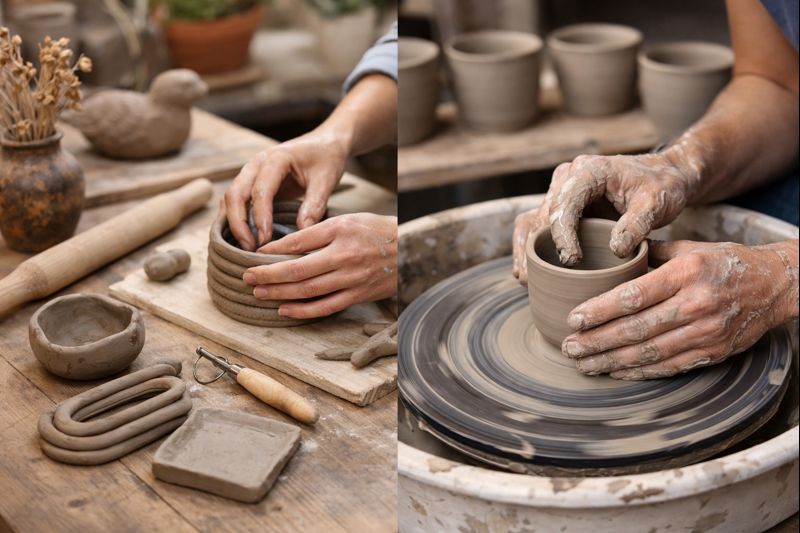
2) You’ll start with beginner-friendly techniques
Most beginners start with either:
- Hand-building (working the clay by hand using pinch, coil, and slab methods), or
- Wheel-throwing (using the wheel to shape forms like cups and bowls)
Not sure which one is for you? We’ve got a full guide that breaks it down in a very beginner-friendly way: [Hand-building vs wheel-throwing for beginners].
3) You’ll make something real (not perfect, but real)
Beginners often create pieces like:
- a small bowl,
- a pinch pot,
- a little planter,
- a soap dish,
- a tumbler-style cup,
- or a simple vase form.
And yes—your first pieces might be a bit wonky. That’s not a failure. That’s pottery. The wonk is part of the charm, and the improvement happens faster than you think.
The pottery timeline nobody warns you about (and why it matters)
One of the biggest surprises for beginners is this:
Pottery isn’t instant.
You don’t usually make something today and take it home finished today—because clay needs time to dry, and the kiln process happens in stages.
Here’s the simplest version of the journey:
- Make your piece (it’s wet and soft)
- Drying time (it firms up slowly)
- First firing (the clay becomes ceramic)
- Glazing (colour and finish go on)
- Second firing (glaze melts and becomes glass-like)
This is why weekly classes are so satisfying—you build momentum and always have something in progress (while something else is drying or being fired). If you want the behind-the-scenes version of the full clay-to-finished process, here’s a great explainer: [From clay to finished ceramics: the full process]
What to wear (and what to bring)
Let’s make this easy: wear something comfortable that you don’t mind getting a little dusty.
Pottery isn’t messy in a chaotic way—but clay does get everywhere in a soft, powdery way. A few quick tips:
- Comfy clothes (you can move, sit, and lean forward easily)
- Short sleeves or sleeves you can roll up
- Closed shoes (especially if you’re in and out of studio spaces)
- Tie long hair back
- Skip rings/bracelets (they get coated in clay fast)
- Short nails help (not essential, but helpful)
In Clayheart’s adult classes, your monthly fee includes tools and firing, so you don’t need to arrive with anything fancy—just yourself.
What you’ll learn in pottery classes (even as a total beginner)
A lot of people think pottery is either:
- “I make mugs like a pro,” or
- “I have no idea what I’m doing.”
The reality is: pottery is a skill you build in layers.
In your first few sessions, you’ll start learning things like:
- How to prepare clay (yes, there’s a right way)
- How to build strong forms that won’t crack
- How thickness affects drying and firing
- How to refine shapes and clean edges
- How glazes behave and how to choose finishes
- How to troubleshoot common beginner hiccups (slumps, cracks, collapsing rims…)
And importantly—you’ll learn patience and presence. Pottery has a way of making time slow down (in the best way).
What happens in a pottery workshop?
A pottery workshop cape town experience is usually designed to be:
- welcoming,
- low-pressure,
- guided,
- and fun (even if you’ve never touched clay before).
Workshops are ideal if you want a single creative outing, you’re celebrating something, or you’re trying pottery for the first time without committing to weekly sessions.
At Clayheart, we host one-off creative events and parties where everything is provided, and the experience is tailored to the group—think birthdays, celebrations, and “let’s do something different this weekend” energy.
Why Clayheart is a lovely place to start pottery in Cape Town
Cape Town has no shortage of creative spaces—but what beginners really need is a studio that feels welcoming, not intimidating.
Here are a few reasons Clayheart works well for first-timers:
- We’re based in Milnerton Business Park (easy to reach, relaxed studio vibe).
- Adult classes are small (max 9 students) so you get guidance without feeling watched.
- Tools and firing are included in the adult class monthly fee, so you can focus on learning and enjoying the process.
- We offer classes, workshops, and private events—so whether you’re a solo beginner, bringing a friend, or planning a celebration, there’s a good fit.
How to book (and what to do next)
If you’re still deciding, here’s a simple path:
- If you want to build a long-term hobby (and actually get good at pottery):
Start here: [Adult pottery classes in Cape Town] {link to Adult Classes page}. - If you want a once-off creative experience (date, birthday, group outing, team day):
Start here: [Creative events and pottery parties in Cape Town] {link to Events and Parties page}. - If you have questions or want help choosing:
Reach out here: [Contact Clayheart]
(We’re WhatsApp-friendly, and we’re happy to help you pick the best option.)