
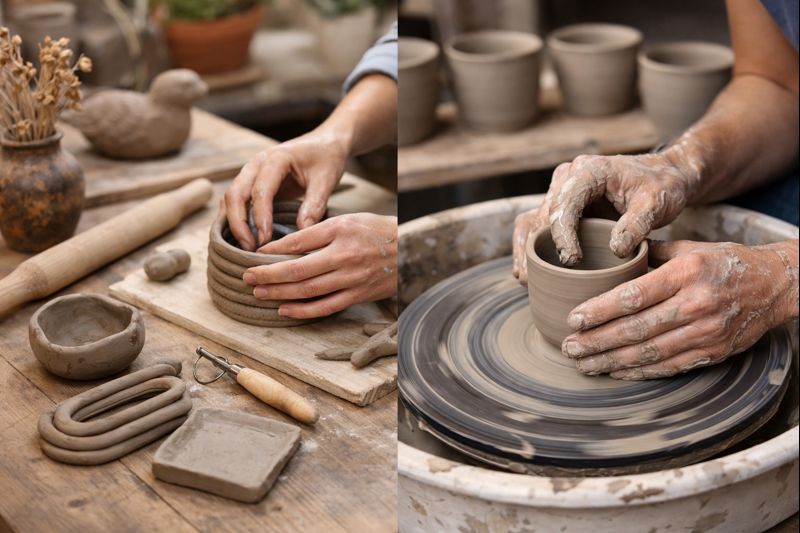
If you’ve been thinking about trying pottery, you’ve probably asked the big beginner question: Should I start with hand-building or learn on the wheel? The good news is that both are excellent entry points, and neither choice locks you in forever.
This guide will help you decide based on what you want out of the experience, how you like to learn, and the kind of pieces you’re excited to make. If you’re in Cape Town, Clayheart’s studio in Milnerton offers beginner-friendly classes (and support for more experienced potters too), so you can start where you feel most comfortable.
The quick answer
Choose hand-building if you want a gentler learning curve, more freedom in shape, and quicker early wins.
Choose wheel-throwing if you’re drawn to the iconic pottery-wheel experience and you like learning through repetition and technique.
Still not sure? Start with the option you’re most excited about. Motivation matters more than “the perfect plan”.
What is hand-building?
Hand-building is exactly what it sounds like: shaping clay primarily with your hands and simple tools. It includes three core techniques that most beginners learn early on:
- Pinch: shaping clay by pinching and compressing it (great for small bowls and organic forms)
- Coil: rolling clay into ropes and building up walls (ideal for vases, planters, larger pieces)
- Slab: rolling out flat sheets of clay and assembling forms (perfect for mugs, trays, boxes)
Hand-building is popular with beginners because it’s more forgiving. You can pause, adjust, and rework the form as you go. It also gives you lots of creative control over texture, surface detail, and asymmetry (in the best possible way). Clayheart’s kids classes, for example, explicitly include hand-building techniques like coil, pinch, and slab work, which shows how accessible these methods are.
What beginners can usually make with hand-building
- Small bowls and snack dishes
- Planters
- Vases (especially coil-built)
- Mugs (slab-built or pinch-built)
- Sculptural pieces and decorative objects
If you want to make something that feels personal and unique from the first few sessions, hand-building often delivers that faster.
What is wheel-throwing?
Wheel-throwing (often just called “throwing”) is the classic pottery-wheel process: you place a ball of clay on the wheel, then use your hands to centre it and pull it up into a form as it spins.
It’s rewarding, but it’s also more technical at the beginning. The first hurdle is centring, which is exactly what it sounds like: getting the clay stable and perfectly aligned while the wheel spins. Once the clay is centred, you can start opening it and pulling the walls to build a cylinder (the foundation shape for mugs, cups, and many bowls).
What beginners can usually make early on the wheel
- Practice cylinders (your “training shape”)
- Small cups or tumblers
- Simple bowls (once pulling is consistent)
Wheel-throwing is a brilliant choice if you enjoy learning skills step-by-step and seeing measurable improvement. For many people, it’s also the most “bucket list” version of pottery.
Hand-building vs wheel-throwing: A practical comparison
Here’s how the two approaches compare for most beginners.
Learning curve
- Hand-building: Generally easier to start. You can get a satisfying outcome sooner.
- Wheel-throwing: Steeper early curve, especially with centring and consistency.
What you can make first
- Hand-building: Wider variety of shapes from the start (including bigger and more sculptural forms).
- Wheel-throwing: Starts more narrowly (cylinders, cups, small bowls) and expands as technique improves.
Time to a “finished piece you like”
- Hand-building: Often faster, because you can slow down and refine the shape more easily.
- Wheel-throwing: Can take longer at first because you’re building foundational technique.
Creative freedom
- Hand-building: High freedom for unique forms, textures, and surface design.
- Wheel-throwing: Beautiful symmetry and refined shapes once your technique settles.
Best suited to…
- Hand-building: Beginners who want a calmer start, love texture, or want quick wins.
- Wheel-throwing: Beginners who want the wheel experience and enjoy practice-based learning.
Which should you start with? Use this decision guide
If you’re still torn, use these “if you…” prompts:
Start with hand-building if…
You want an easier entry point and a higher chance of liking what you make early on.
You love texture and detail (patterns, carving, stamping, surface work).
You want to explore sculptural forms like planters, vases, trays, and organic shapes.
You’re nervous about “being bad at art” and want a more forgiving process.
Start with wheel-throwing if…
- You’ve always wanted to try the wheel and that’s the experience you’re excited about.
- You like learning a skill through repetition and you find improvement motivating.
- You’re drawn to functional pieces like cups, mugs, and bowls with clean symmetry.
- You enjoy technical challenges and want a strong technique foundation.
If you’re doing it as a gift, date, or group activity…
Choose the experience that matches the story you want afterwards:
- If you want playful experimentation and variety, hand-building is often a hit.
- If you want the classic “pottery wheel” moment, go for wheel-throwing.
And if you’re not sure, the simplest rule is this: start with what you’ll show up for. Consistency matters more than choosing “the perfect” first method.
A note on confidence: you don’t need to be “artistic”
Many first-timers arrive with the same concern: “I’m not creative.” Pottery is a skill, not a personality trait. Your first pieces might be a little wonky. That’s normal. Clay teaches you through touch and repetition, and every session makes your hands more confident.
Clayheart leans into pottery as a grounding, expressive practice and a space for community, not perfection. That mindset is particularly helpful for beginners.
How Clayheart supports beginners (and pros)
If you’re starting in Cape Town, Clayheart’s studio is based in Milnerton Business Park and offers pottery classes and workshops, with options for adults and kids, plus private events and parties.
For adults, Clayheart runs weekly classes and notes that the monthly fee includes tools and firing, with a small class size (max 9 students), which is ideal for beginners who want guidance while still having space to experiment.
If you’re unsure which path fits you best, it’s worth sending Clayheart a quick message about what you want to make (mugs, planters, bowls, sculptural pieces) and what kind of learning style you prefer. Their contact details are published on the site (email, WhatsApp, and studio address).
FAQs
Is hand-building easier than wheel-throwing?
For most beginners, yes. Hand-building tends to be more forgiving and less technical early on. Wheel-throwing is highly rewarding, but it usually takes a little longer to get consistent results.
Do I need experience to start a pottery class?
No. Clayheart offers beginner-friendly options and supports a range of skill levels, including experienced potters.
What should I wear to a pottery class?
Comfortable clothes you don’t mind getting dusty, and closed shoes. Clay washes out, but it can be messy while you’re learning.
How long does it take to finish a pottery piece?
Pottery takes time because pieces need to dry fully and then be fired. Your instructor will guide you through the process and expected timelines.
Can kids do wheel-throwing?
Kids often start with hand-building techniques (pinch, coil, slab) because they’re accessible and fun. Some studios introduce wheelwork depending on age and class format. Clayheart’s kids classes highlight hand-building methods as part of what children learn.
What if I’m not “creative”?
Pottery is a hands-on skill. You learn by doing, and your creativity grows as your confidence grows. Beginners are welcome.
Final thought: start where you’ll enjoy the process
If you want the simplest path to a piece you’ll love early on, start with hand-building. If you want that classic pottery-wheel experience and you enjoy learning technique through practice, start with wheel-throwing. Either way, you’ll be learning the same fundamentals: how clay behaves, how to shape it, and how to finish something that’s genuinely yours.
Ready to start? Explore Clayheart’s adult classes, kids classes, or enquire about workshops and private events at their Milnerton studio.